Sunday, April 19, 2015

Unification in the Twenty-First Century

Prospects 

Image result for the elegant universe
Science is an ever changing field that is based in fact and imagination. The lessons of the past will be useful for the future. The things we've learned in the last hundred years have showed us that the laws of physics are heavily associated with symmetry. The law of special relativity is symmetrical with principles of relativity. This final chapter of the book asks questions about not only science but also humanity. Some of the most of the most important questions which were asked I now turn to you. Are there limits to what science can explain, can we know everything about our universe? Finally, the most important question, will we ever be done? These questions may take generations to answer, and they possibly may never be answered, but that should never discourage us to keep reaching for the stars.This is the conclusion of my blog about The Elegant Universe written by Brian Greene.

String Theory and the Fabric of Spactime Part 2

Black Holes: A String/ Theory Perspective

Jacob Berkenstein in 1970 came up with the theory of black hole entropy. This hyperlink will better explain this theory. The main point is that because a black hole has such a high amount of entropy then the event horizon will increase. This was widely discredited because of previous thoughts that black holes were very orderly. But using string theory we can actually see the disorder of the vast amount of entropy in a large black hole. Using previous general relativity and quantum mechanics will not be able to quantify the things we are trying explain.


Reflections on Cosmology 

When the universe was first burst into existence and while many things occured something to take notice of is what we call primordial nucleosynthesis. This was the period in which the universe began to cool and quarks formed into groups of three which formed protons and electrons.   

Scientists will use very powerful telescopes to view the universes expansion as we have previously discussed. These telescopes not only have picked up this expansion but something called, cosmic background radiation.  This led scientists to thinking that at one point the universe was exactly the same at all points and there was no places of high entropy where black holes were located. A picture of this radiation of the universe is located below. 


Multiverses 

The theory of there being multiple universes is one that holds that different universes hold different rules. In our universe we are in a constant outward expansion, but others may experience expansion at different times. This would then allow different universes to have different physical laws than our own. 

String Theory and the Fabric of Spactime Part 1

The universe is expanding outward since it was first given existence by a violent singular cosmic explosion about 13 billion years ago. This expansion still puzzles scientists to this vary day, some believe that the expansion will come to a stop, then actually reverse. This will then lead to something called a cosmic implosion. Which is the universe reverting back to its initial singular form before the big bang. Galaxies will approach each other slowly at fist and as more time progresses the speed does at rapid and exponential rates. This is just one theory of what could happen but there are more.

Tearing the Fabric of Space

If you'll remember our previous analogy of space being like a rubber membrane. When a rubber membrane is stretched continuously or with enough force the rubber will tear. This may seem like an error on the use of a rubber membrane for our comparison, space surely can not tear like rubber can. If you followed general relativity then you would be correct in the thinking that space can not tear. But following string theory you start to see that tears are common things in spatial fabric at quantum level, also at a macro level . This is the concept behind what we call wormholes(the things from Star Trek and Interstellar). A wormhole really is just a bridge or tunnel that is essentially a shortcut from one point of the universe to another. 
The wormhole does not just connect two existing regions of space, but in fact tit creates a whole other different region of space(shown in the diagram as the wormhole. 

Beyond Strings: In Search of M-Theory 

In talking of string theory it may have been confusing, so what I am about to say is going to be a bit rough. String theory is not just a single theory but in actuality there are five variations of string theory(called: Type 1, Type 2 A, Type 2 B, Heterotic-O, and Heterotic-E). But there is one theory that unites al five of this theory. This theory is called the M-Theory. The video and link are better ways of understanding M-Theory. 

Monday, April 13, 2015

The Cosmic Symphony Part 2

More Dimensions Than Meet the Eye

There are the three spatial dimensions and one time, the ones we previously discussed. But with string theory we find that multiple dimensions are not just permitted but required. But these other dimensions are not large like the other spatial dimensions we know, they are in fact very smaller, way smaller and curled. These curled dimensions are so small in fact that they evade direct detection by our means of magnification. This approach to viewing the different dimensions is developed by The Theodor Kaluza. 


So now with this understanding we have four spacial dimensions and one time, which makes it five dimensions. This theory of extra, tiny dimensions is called the Kaluza Klein theory. After calculations using string theory it was found that for this to be true strings can not move in four spatial dimensions. In fact they need to move in nine, which makes it so that we would have nine spatial dimensions including one time, making ten dimensions. There is another that we will touch on in future posts. These other dimensions are smaller and retrospectively evading our detecting. 

The next posts will be getting more interesting and at the same time confusing. As always if you have questions feel free to ask. 

Monday, April 6, 2015

The Cosmic Symphony Part 1


String theory as we said gives a unification between Einstein's general relativity and the laws of quantum mechanics. We also talked about how strings make up the world around us being the heart of matter. This was previously questioned as to what then makes up strings if strings makes up matter. There are two possible answers that we can use when asked this question, one being we don't know. There is not nearly enough evidence for us to have a definitive answer, so we will rely on the fact that if other information comes to contradict string theory, then it can be wrong. The second answer we have is that strings aren't made of anything. They represent the end of the line, it can be explained using other terms in our English. Paragraphs are made up of sentences, which in turn are made up of words. These words are made up of letters, but letters are the end of the line, letters are the equivalent of strings(but much smaller). 

Unification though String Theory 

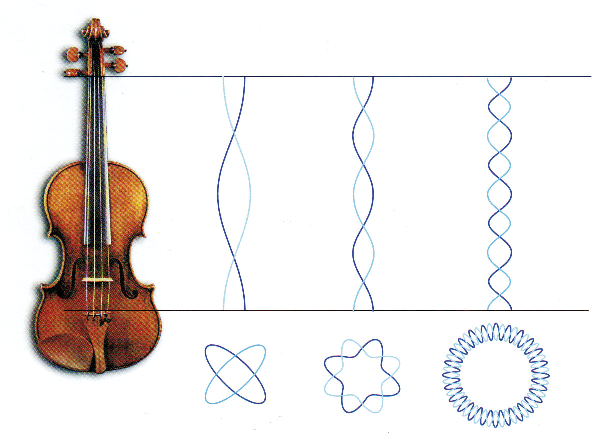
Strings as we said through different oscillations and vibrations make up matter. These vibrational patterns are known as resonances. The different patterns of a string give different masses and charges. 

Special relativity tells us that energy and mass are interchangeable, the greater the energy the greater the mass and vice versa. Particles that are heavier require strings that have more energy, just as lighter particles require strings that are less in energy.

There are two reasons why strings in string theory are so special. The first being that although being spatially extended they are explained in the framework of quantum mechanics. The second being that the differeent resonances have a specific one being the properties of the gravitron. This meaning that gravity and gravitational force plays a part in the structure. This is something that is very different than quantum mechanics where gravity is not so looked at. 

In the upcoming posts we will talk more about sting theory and more dimensions than meet the eye.