Monday, March 16, 2015

The Dilemma of Space, Time, and the Quanta Part 1

The Principle of Relativity 

In the book, the principle of relativity declares that all constant velocity observers are subject to an identical set of physical laws, this then means that constant velocity observers are justified in making the claim that they are at rest. Before you can talk about speed or velocity, the means of measuring tit must be established. Let us use the example from the book to properly explain this and the principle of relativity. George is in space with a spacesuit that has a continuous, flashing green light. George is in absolute darkness and is completely still. Off in the distance he sees a flashing red light slowly coming towards him. After some time he sees Gracie who like him is in space, they wave at each other and Gracie passes by him, slowly fading into the distance. From Gracie's perspective, she is stationary and George passes by her. So you may be asking yourself, who is right, who is moving? The answer is they are both correct, both of these viewpoints have equal standings, both felt stationary and saw the other as moving, This example can be used to explain the meaning behind the principle of relativity. Using this we can say that the concept of motion is relative.When speaking about motion of an object relative to or by comparison of another object. This means that, Susan travels 5 miles per hour has no real meaning. But, Susan travels 5 miles per hour past Jessie does hold meaning because there is an established benchmark. We can say then that there is no absolute notion of motion. 

Truth and Consequences

Time elapses more slowly for an individual that is in motion than an individual that is at rest. You may come to the conclusion that if someone is at motion rather than staying at rest, then they should be able to live longer. If people were able to move as fast as let's say muons, they would live 700 years, instead of 70 years. But the people living longer aren't actually living longer they are moving, slower. From the perspective of those living 70 years the people living 700 years are moving at a hyper slow motion pace. To them they are living an average 70 year life, but one of their normal life cycles is a much greater amount of time to a 70 year person's time. So from this what conclusion can we make. Well one being that time is affected by motion. But what is time, most definitions will either use the word time or use long explanations in order not to use the word, time. Let's say that you are driving in a straight line at 100 miles per hour down a road 10 miles long. It would take six minutes to complete because it is a tenth of an hour and 100 miles per hour. But what if you drive at an angle, well then you now you see your time has increased from six minutes to seven and eight minutes. Why is this happening, well let's consider that going in a straight line is two spatial dimensions. The time it takes to clear the road is increased because it is traversing through another dimension, time itself. Time is our fourth dimension, when we ask to meet someone we tell them where in space we want to meet them. But something as important is when we want to meet them. The dimensions are three in space and one that is located in time. Let's end this post with talking of the light speed. Say we took a muon for example and propelled it at great speed, enough to have it reach 99.9999999 the percent the speed of light. There is a specific reason why we can't just push it a little harder to get it to the speed of light. That reason is that as the speed increases for the muon the more massive it becomes. So as it increases its speed the more difficult it becomes to increase its speed. The mass would increase without limit as the speed gets closer to the speed of light. To break that barrier it would require an infinite amount of energy. But this is impossible, meaning that nothing travels faster light. 

Saturday, March 7, 2015

The Edge of Knowledge Part Two

String Theory: The Basic Idea 

     String theory is a term that will be used throughout these blogs. But the key word to focus on is string, so what are strings. Matter itself is composed of many different microscopic things that you've learned about in your biology, chemistry and physics. Matter is composed of atoms, atoms are made up of smaller things like electrons. But for a long time the edge of our knowledge stopped at this level. We thought that these were the smallest pieces of matter that were in our universe, until quarks. Quarks are divided into six different varieties; up quarks, down quarks, charm quarks, strange quarks, top quarks bottom quarks. Quarks are fascinating in it of itself but I won't take to much time on it. What encompasses the quarks are what we call strings, which are vibrating and looping and shaping matter. Although not clear at this vary moment string actually resolves the problem of general relativity and quantum mechanics being incompatible with each other. How, will be a discussion piece a little further down the line. I've enclosed below a diagram that shows the inner workings of matter:

String Theory as the Unified Theory of Everything

String theory provides an explanation that is capable of bringing together all forces and all matter. According to string theory the vibration of the strings then shape the very things we see around us. A proton is in its simplest form a string oscillating one way, just as a quarks strings vibrating another way. Instead of a chaotic collection of physical experimental facts, in string theory the properties of particles are all just the pattern of vibration, the loops of string. This is one of the most quintessential pieces of string theory, it is for the first time a framework for physics that doesn't just relate to two theories; quantum mechanics and general relativity. No, it will give us an explanation to every, fundamental feature down to the most microscopic feature on which our very universe is based and built upon. This is why string theory is named at times the "theory of everything" or the "ultimate" or "final" theory. The discovery of the theory of everything, the greatest explanation of the universe, in which it does not need any deeper type of explanation. This theory will not mean that all scientific fields have been solved, it actually means the opposite. It means that for once will have an unshakable, absolute foundation in which we can build our understanding of the world and of, the universe. 

Sidenote: This was all just the tip of the iceberg, the upcoming blog posts are going to slowly get deeper into string theory and the universe in which string theory would suggest we live in. They will become more complicated as we go along so feel free to ask questions and if I cannot give you one right away, know that I'll be diving into the book to find one. 

Sunday, March 1, 2015

The Edge of Knowledge Part 1

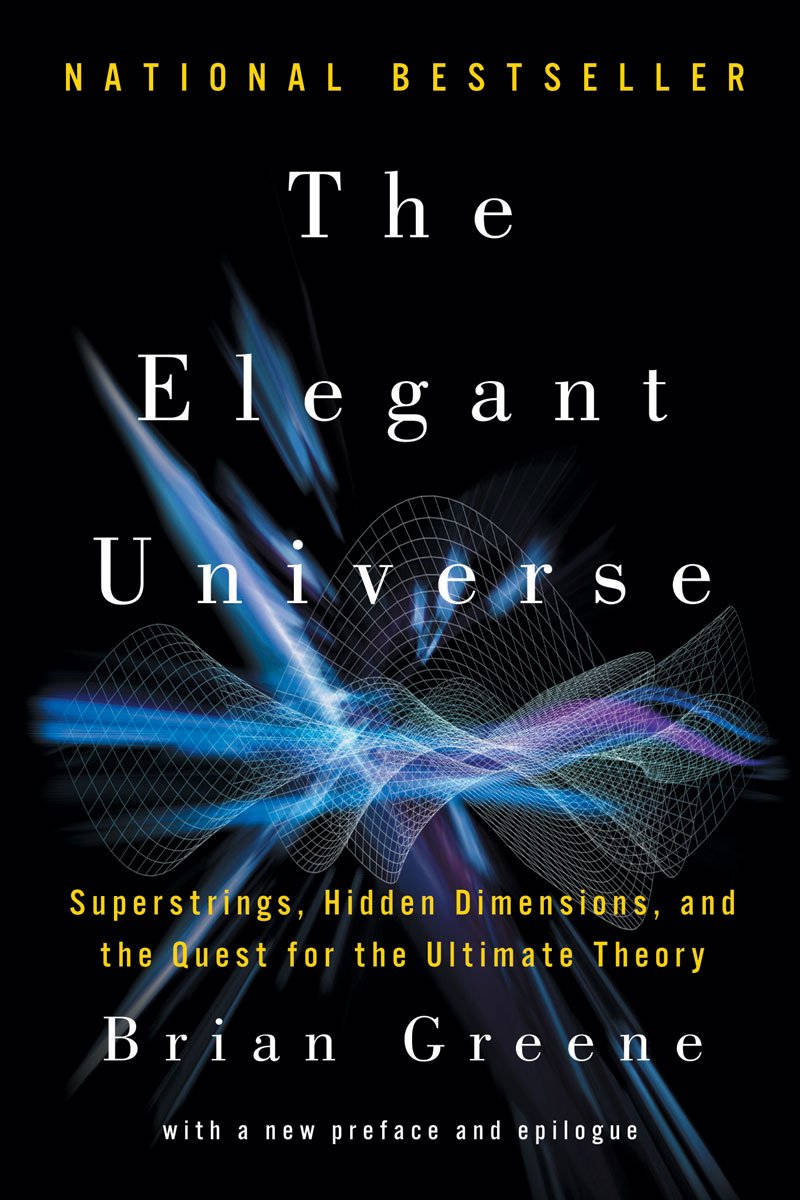
I began reading The Elegant Universe by Brian Greene. The above image is the cover of our topic book. Through this book we will try to unravel the mysteries of the universe and open up and exam the two types physics: quantum mechanics and general relativity. Through these two fields of physics we have made many breakthroughs in the physics world but there has always been tension between the two. When the equations are both combined they no longer hold up. This is where the superstring theory(string theory for short) comes into play. The superstring theory resolves the tension between the two, but it does not end there it also has general relativity and quantum mechanics to require one another in order to work. string theory as quoted in the book, "has the potential to show that all of the wondrous happenings in the universe...are reflections of one grand physical principle, one master equation."There are three conflicts between quantum mechanics and general relativity. The first being in the late 1800s, the laws of motion say that if you run fast enough you can catch up to a beam of light departing. But the laws of electromagnetism would disagree with the laws of motion. This was resolved by Einstein with his theory of special relativity, this states that space and time can no longer be viewed as universal concepts that are absolute that are experienced by everyone the same. This theory of special relativity although solved the first conflict it also set in motion the second conflict. Einstein concluded that no object could travel faster can travel faster than the speed of light. The universal theory of gravitation uses the concept that there are influences that are transmitted through large distances of space instantaneously, far faster than the speed of light. This was resolved by the general theory of relativity like before this overturned our thoughts on space and time previously held. Special relativity gave us the understanding that space and time are influenced by one's state of motion. General relativity would take it a step forward to say that space and time can also be warped and curved in response to matter and energy being present.  But like the first time the theory used to resolve the conflict ended up setting the stage for another. Beginning in 1900, three decades were used to develop quantum mechanics. This is because of the fact that our current concepts on physics did not work when applied to the microscopic world. The third conflict is one that comes from quantum mechanics and general relativity not working together. The conflict is named the central problem with modern physics. String theory offers a resolution to this conflict, this is where things get interesting with this theory. It is known that in this universe we have three spatial dimension. But string theory would claim that there are many more dimensions hidden within our universe, hidden in the folded fabric of the cosmos.